DRIVING TIP #4: Don’t drive with your disabled placard on your mirror
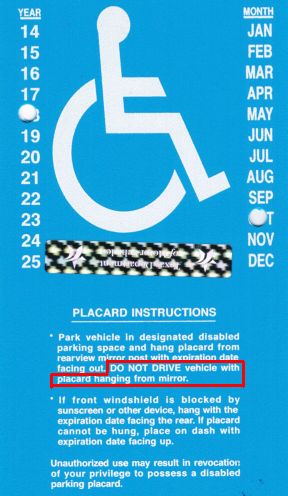 How often do you see someone driving around with the big, blue (or sometimes red) disabled parking placard hanging from their rearview mirror? If you’re like me, probably all the time.
If you’re one of those people doing that, then you’re doing it wrong.
Besides the fact that it explicitly says “DO NOT DRIVE vehicle with placard hanging from mirror” in the instructions on the back of the permit (yes, you’re supposed to take the time to read those words there), and although it’s not specifically illegal, it should be common sense that leaving something that big on your mirror while driving blocks a non-trivial portion of your field of vision, an inherently dangerous proposition. Admittedly, it’s maybe 10% or so of your view, but something could be in that area that makes all the difference, so why take that chance? It only takes a couple of seconds to take it down from your mirror before driving and put it back up there when you park in a reserved spot.
Automobiles Laws and policies Safety: Driving tips
by Brian
Comments Off on DRIVING TIP #3: Wait in the intersection to turn left
DRIVING TIP #3: Wait in the intersection to turn left
 In my previous tip, I discussed not blocking intersections. Today, I’ll discuss a time when it’s okay to wait in the intersection.
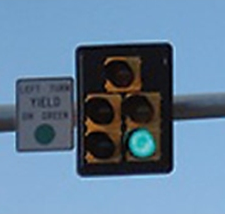
Sometimes you’ll come to an intersection where you want to turn left and there’s a flashing yellow arrow or a circular green signal but no green arrow at the time you want to turn. In this situation, I usually see people dutifully wait behind the stop line. Then the light turns red and they’re still sitting there. Even worse are intersections that don’t have a protected left arrow at all– I’ve seen people wait behind the line through multiple cycles because oncoming traffic is too heavy to allow them to turn. Occasionally they’ll even give up.
Instead of waiting behind the line, the best thing to do if you need to wait to turn left is to move part of the way into the intersection and wait there. Then, if the light turns red before you’re able to turn, the oncoming traffic will stop and you can complete your turn.
Automobiles Laws and policies Safety: Driving tips
by Brian
Comments Off on DRIVING TIP #2: Don’t block the box!
DRIVING TIP #2: Don’t block the box!
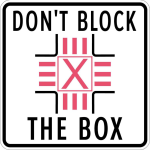 This week, San Antonio police began targeted enforcement of the state’s law against stopping in an intersection. The stepped-up enforcement is part of a pilot project called “don’t block the box”, where the “box” is the intersection and adjacent crosswalks. The program is modeled on similar programs in other cities. Ten problematic intersections all over San Antonio are part of this pilot project and have had signs like the one shown here installed. (Understand, though, that the law applies to all intersections, not just those marked with signs.) This is a statewide problem, so keep reading even if you’re not in San Antonio.
Automobiles Laws and policies Safety: Driving tips
by Brian
Comments Off on DRIVING TIP #1: Scan the road
DRIVING TIP #1: Scan the road
For this first bite-sized driving tip, I’m picking a topic that’s not even discussed on my Texas traffic laws page— scan the road.
Driving down the right lane of a major street recently, I crested the top of a hill and immediately saw a stalled truck in my lane nearly a mile down the road. Traffic in both lanes was light enough to easily change lanes, so I moved to the left lane as soon as I saw the hazard. There were two other cars traveling in the right lane ahead of me and BOTH of them continued down the lane until they were nearly on top of the broken-down truck. At that point, they had to hit their brakes and make a sudden lane change to avoid hitting it.
“WTF? Are these people blind?”
Automobiles Laws and policies Safety: Driving tips
by Brian
Comments Off on Driving tips coming soon
Driving tips coming soon
The top-viewed page on my website texashighwayman.com is consistently the page on Texas traffic laws. It’s obviously a topic lots of folks are interested in. And from what I’ve seen on the roads, lots more folks need to look at it. 🙂
While that page was initially intended to highlight common questions folks have, it’s become quite comprehensive over the years. If you take the time to read the whole thing, it’ll take you while and you’ll feel like you’ve been drinking from a fire hose. So, I’ve decided to parcel-out some of the topics from that page in smaller doses here over the next few months, along with some additional tips that aren’t covered on that other page.
If you’re interested, I’ll announce postings on my Twitter and Facebook pages or just check back here periodically.
Until then, drive safely!
more »
Construction and closures Roads Safety: Alamo Ranch Parkway Loop 1604 SH 151
by Brian
11 comments
Alamo Ranch Parkway intersection getting lots of criticism
The recent opening of the overpass from SH 151 to Alamo Ranch Parkway is drawing lots of fire from residents of the area claiming that the new design is dangerous. As if on cue, a tragic crash claimed the lives of three people at that intersection just four days after the overpass opened. However, it should be noted that the crash happened on the eastbound side of ARP prior to the overpass, not coming off of it, so the overpass played no direct role in the crash.
That said, the increase in traffic caused by the overpass is overwhelming the four-way stop at ARP and Westwood Loop. The county has a traffic signal under construction there that will surely ease many of the problems folks are complaining about once it goes into operation, currently expected by the end of January. The county planned to have it operational by the time the overpass opened, but the construction of the new Casa Blanca Theater there required them to change the design in order to accommodate the driveway from the theater. Unfortunately, there was a significant delay in getting the plans for that driveway from the developer, which delayed the signal project.
Construction and closures Roads Safety: Fredericksburg Road Medical Drive South Texas Medical Center
by Brian
Comments Off on Ribbon cut on Fred-Med project
Ribbon cut on Fred-Med project
After nearly 20 years in the making, TxDOT, COSA, and South Texas Medical Center officials celebrated the completion of the Medical Drive underpass at Fredericksburg Road this morning with a ribbon-cutting ceremony and opened the new lanes to traffic a short time later.
The nearly $15 million project was primarily done for safety, namely allowing ambulances quicker access to the Medical Center from I-10, bypassing the oft-congested Fredericksburg/Medical intersection. As if on cue, the wailing siren from an emergency vehicle trying to navigate the intersection above interrupted the ceremony. After the ribbon was cut, an ambulance and EMS squad truck were the first vehicles to “officially” use the underpass.
Texas road-rage accidents dashboard
When are drivers likely to lose their cool, to the point of rage?
I figured the hours after bars closed on weekends were the hot times. But that’s not true, according to a state road-rage database obtained by the Express-News.
I put together an online dashboard to query the database, which is hosted as a Google Fusion Table. It’s a great way to get a quick snapshot of layered filters, such as age, gender, ethnicity, days, times, etc.
Try it out below. For convenient side-by-side comparisons, click the “Compare Two Views” button under the dashboard.
I gleaned a few interesting insights myself.
Paying too much for car insurance?
If you’re in Texas, odds are you’re paying more for car insurance than the average U.S. driver, says a survey by Insure.com.
I ran the survey’s data through Google Fusion Tables to see a bigger picture, and it turns out costs are as varied as the nation’s landscape itself. In particular, extreme highs touch all three coasts as well as the Canadian and Mexican borders.
Hover over states to see average costs. The darker the shade, the higher the cost.
Reasons for the undulating costs are, literally, all over the map, from claim-happy and disaster-prone Louisiana and bumper-to-bumper traffic in Georgia, to slow-poke drivers in Iowa and strict teen-driving laws in Maine, according to Insure.com.
The survey looked at 2013 cars and settled on a typical guy with a clean record and good credit. Texas rolled in at $1,545, ranking 19th overall.
Texas joined 19 other states and D.C. to rank higher than the $1,510 national average. Louisiana tops the list with $2,699. Maine sits at the bottom with $934.
Here are the top 10. Again, use hover to see dollars. The full table’s here.
Laws and policies Roads Safety: Speed limits Texas Department of Transportation
by Brian
4 comments
75 mph coming to SA area Interstates!
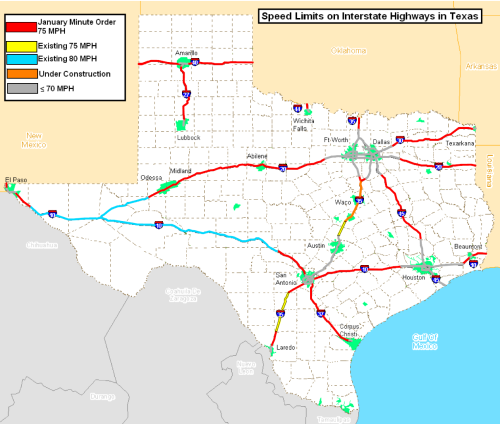
The Texas Transportation Commission approved increasing the speed limit to 75 mph on about 1,500 miles of mostly-rural Interstate highways in the state. Around the San Antonio area, the following stretches will see 75 mph signs soon:
- I-10 West from Loop 1604 to past Kerrville (where it’s already 80 mph)
- I-10 East from just outside Loop 410 to Waller County west of Houston
- I-35 South from Palo Alto Rd. to the existing 75 mph section south of Devine
- I-37 from just inside Loop 410 to Corpus Christi
I-35 between San Antonio and Austin was not approved for the higher speed limit.
The Legislature approved the higher speed limits last year.
More information
- TxDOT’s 75 mph page – http://www.txdot.gov/safety/speed_limit/75mph.htm