Gas taxes History Roads Toll roads: Alamo Regional Mobility Authority Loop 1604 MPO Texas Department of Transportation US 281 widening
by Brian
Comments Off on Why haven’t they widened Loop 1604?
Why haven’t they widened Loop 1604?
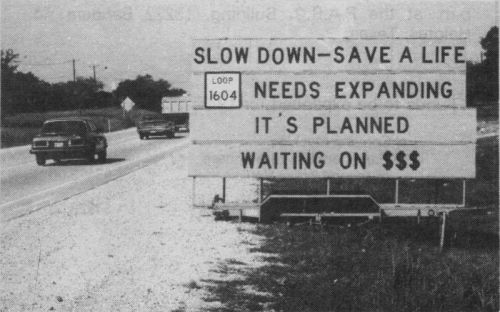
A sign on Loop 1604 in 1983 – It’s just true today as it was then!
One of the biggest gripes among San Antonio drivers is that Loop 1604 North, from roughly Bandera Rd. to I-35 on the northeast side, is still just two lanes each way and, as a result, is often congested. It may seem like TxDOT isn’t doing anything about it, but that’s not the case. An expansion of 1604 has been in the works since the last millennium, but has gotten sidetracked for several reasons over the years. Fortunately, there is light at the end of the proverbial tunnel.
The Flyover Fairy finally blesses San Antonio
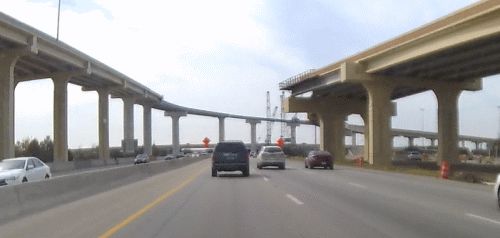
Framegrab from dashcam video of work on the SH 151/Loop 410 interchange flyovers
Ask any roadgeek (yes, it’s a thing) and they’ll tell you that nobody (perhaps with the possible exception of California, blah!) does freeway flyovers like Texas. And in Texas, Houston was once the undisputed King of the Flyover, although Dallas had had a nice collection of big– albeit cookie-cutter– interchanges since the ’70s even before the impressive “High Five” interchange came along in 2005. But while doing a drive through of the abundant road work over in the SH 151 and US 90 areas here in San Antonio earlier this week, I couldn’t help but be impressed by dizzying number of flyovers now under construction here and it got me to thinking about the number of such interchanges either already open, under construction, or coming soon here in “the 210” (or is it now “the 210/726”?)
Commuting Roads Transit: HOV lanes I-10 Texas Department of Transportation US 281 widening
by Brian
Comments Off on Not gonna use the HOV lane? It still benefits you!
Not gonna use the HOV lane? It still benefits you!
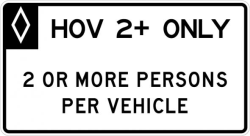
TxDOT is preparing to build San Antonio’s first two high-occupancy vehicle (HOV) lanes on I-10 West and US 281 North. Construction of both is scheduled to start this year.
One comment I frequently hear about HOV lanes is from people saying they won’t use them, so they won’t benefit from them. A corollary of that is that people who won’t use them don’t think their tax money should be spent on them. As is often the case, both of these viewpoints fail to see the bigger picture.
Construction and closures Roads Safety: Alamo Ranch Parkway Loop 1604 SH 151
by Brian
11 comments
Alamo Ranch Parkway intersection getting lots of criticism
The recent opening of the overpass from SH 151 to Alamo Ranch Parkway is drawing lots of fire from residents of the area claiming that the new design is dangerous. As if on cue, a tragic crash claimed the lives of three people at that intersection just four days after the overpass opened. However, it should be noted that the crash happened on the eastbound side of ARP prior to the overpass, not coming off of it, so the overpass played no direct role in the crash.
That said, the increase in traffic caused by the overpass is overwhelming the four-way stop at ARP and Westwood Loop. The county has a traffic signal under construction there that will surely ease many of the problems folks are complaining about once it goes into operation, currently expected by the end of January. The county planned to have it operational by the time the overpass opened, but the construction of the new Casa Blanca Theater there required them to change the design in order to accommodate the driveway from the theater. Unfortunately, there was a significant delay in getting the plans for that driveway from the developer, which delayed the signal project.
Construction and closures Roads Safety: Fredericksburg Road Medical Drive South Texas Medical Center
by Brian
Comments Off on Ribbon cut on Fred-Med project
Ribbon cut on Fred-Med project
After nearly 20 years in the making, TxDOT, COSA, and South Texas Medical Center officials celebrated the completion of the Medical Drive underpass at Fredericksburg Road this morning with a ribbon-cutting ceremony and opened the new lanes to traffic a short time later.
The nearly $15 million project was primarily done for safety, namely allowing ambulances quicker access to the Medical Center from I-10, bypassing the oft-congested Fredericksburg/Medical intersection. As if on cue, the wailing siren from an emergency vehicle trying to navigate the intersection above interrupted the ceremony. After the ribbon was cut, an ambulance and EMS squad truck were the first vehicles to “officially” use the underpass.
Construction and closures Roads: construction Loop 1604 Texas Department of Transportation widening
by Brian
Comments Off on Loop 1604 West expansion continues
Loop 1604 West expansion continues
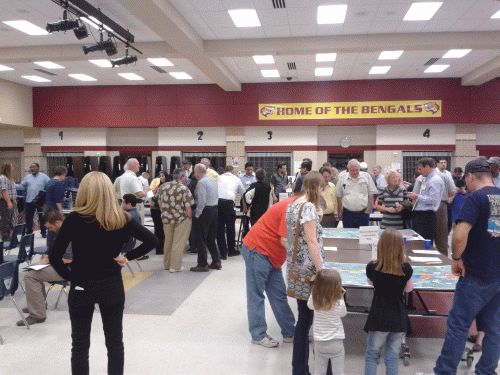
TxDOT held an open house on March 18th to show their plans to improve Loop 1604 from Culebra south to Potranco. That section of the loop is currently a four-lane divided highway with signalized intersections at SH 151, Wiseman, Military, and Potranco. This project will upgrade that section of the loop to an expressway by adding overpasses at Wiseman, Military, and Potranco and building access roads and associated entrance and exit ramps. The intersection of SH 151, although technically included within the project limits (mainly for signage purposes), would not see any actual changes with this project (more on that later.) The $69 million project is set to begin in about a year and will take about 2 1/2 years to complete.
Construction and closures Roads: construction DeZavala Road I-10 widening
by Brian
Comments Off on What’s going on at I-10 and DeZavala?
What’s going on at I-10 and DeZavala?
If you’ve traversed I-10 at DeZavala recently, you may have noticed that the center divider is being removed. Many folks have noticed and I’ve gotten the question more than once asking why. A few have even asserted that they’re ripping out brand new barrier that was just re-built recently.
First off, the barrier that’s being removed is not new. Yes, there have been several sections of barrier that were re-built in that same project area recently, but all of that was south of the Fredericksburg/Woodstone area. You can tell the new barrier because it’s still the raw, dark gray color. The old barrier is tan, and that’s what’s being removed at DeZavala.
Now to answer the “why”. I-10 is being widened in that area, and consequently the DeZavala overpass needs to be widened to carry those additional lanes. But it turns-out that the overpass also needs to raised a few feet in the process. This means that they’ll have to tear-down the old overpass. In order to do that, traffic will need to be shifted from one side of the overpass to the other while half of the bridge is demolished and re-built. Therefore, the divider is being removed to allow for that traffic switch as well as the fact that it will need to be removed anyway since the bridge it sits on is being replaced.
Construction and closures Roads: Braun Road construction Loop 1604 Shaenfield Road Texas Department of Transportation widening
by Brian
1 comment
Loop 1604 project breaks ground
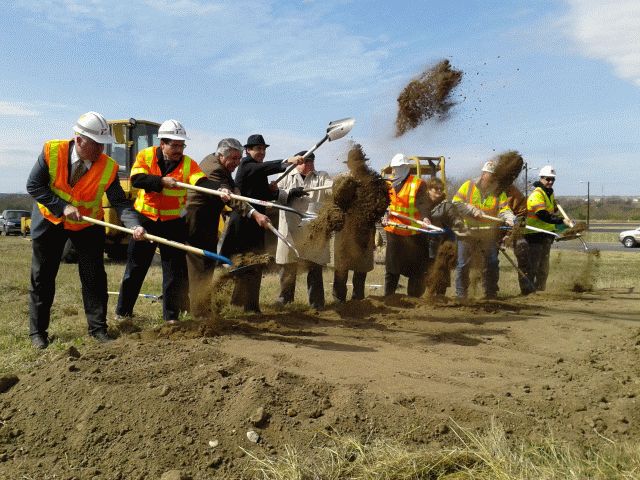
It was so cold that I could feel my brain starting to freeze, but yours truly was standing out in the median of Loop 1604 between Braun and New Guilbeau this morning to witness the groundbreaking of the long-awaited Loop 1604 expressway project. This $82 million project will extend the existing toll-free expressway cross-section at Bandera Rd. south to Culebra by building overpasses at Braun, New Guilbeau, and Shaenfield and adding continuous access roads and associated entrance and exit ramps. It is expected to take about 28 months or so to complete.
Data visualizations Gas taxes Laws and policies Roads Transit
by Patrick
Comments Off on Texas drivers help pay tab for roads in other states
Texas drivers help pay tab for roads in other states
When you look at how much Texas drivers hand over to Washington and how much comes back, it’s easy to feel like the feds don’t like us much.
Federal officials do not “directly” return a whopping 78 percent of fuel and vehicle taxes collected in Texas. That’s second highest among states; behind Iowa with its 84% bye-bye rate and well ahead of third-place Florida.
Unfortunately, though, there’s a bigger untold story here. Officials invested more than half of those collections into projects straddling one or more states. And the data doesn’t show how those amounts were distributed among states.
So the 78% no-return likely isn’t as bad as it looks. Texas probably received more. Still, hover over the interactive map above and you’ll see a wide range of give and take, including Alaska’s 60 percent gain.
The data, from fiscal 2011, is the latest from the Federal Highway Administration. I saved it to a CSV file and used D3.js, with an assist from ColorBrewer.js and some custom javascript, to display it here. Have fun.
Texas road-rage accidents dashboard
When are drivers likely to lose their cool, to the point of rage?
I figured the hours after bars closed on weekends were the hot times. But that’s not true, according to a state road-rage database obtained by the Express-News.
I put together an online dashboard to query the database, which is hosted as a Google Fusion Table. It’s a great way to get a quick snapshot of layered filters, such as age, gender, ethnicity, days, times, etc.
Try it out below. For convenient side-by-side comparisons, click the “Compare Two Views” button under the dashboard.
I gleaned a few interesting insights myself.