Gas taxes History Roads Toll roads: Alamo Regional Mobility Authority Loop 1604 MPO Texas Department of Transportation US 281 widening
by Brian
Comments Off on Why haven’t they widened Loop 1604?
Why haven’t they widened Loop 1604?
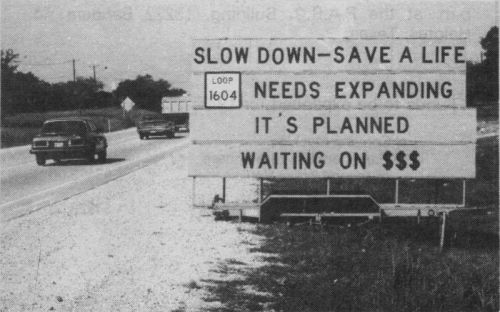
A sign on Loop 1604 in 1983 – It’s just true today as it was then!
One of the biggest gripes among San Antonio drivers is that Loop 1604 North, from roughly Bandera Rd. to I-35 on the northeast side, is still just two lanes each way and, as a result, is often congested. It may seem like TxDOT isn’t doing anything about it, but that’s not the case. An expansion of 1604 has been in the works since the last millennium, but has gotten sidetracked for several reasons over the years. Fortunately, there is light at the end of the proverbial tunnel.
Data visualizations Gas taxes Laws and policies Roads Transit
by Patrick
Comments Off on Texas drivers help pay tab for roads in other states
Texas drivers help pay tab for roads in other states
When you look at how much Texas drivers hand over to Washington and how much comes back, it’s easy to feel like the feds don’t like us much.
Federal officials do not “directly” return a whopping 78 percent of fuel and vehicle taxes collected in Texas. That’s second highest among states; behind Iowa with its 84% bye-bye rate and well ahead of third-place Florida.
Unfortunately, though, there’s a bigger untold story here. Officials invested more than half of those collections into projects straddling one or more states. And the data doesn’t show how those amounts were distributed among states.
So the 78% no-return likely isn’t as bad as it looks. Texas probably received more. Still, hover over the interactive map above and you’ll see a wide range of give and take, including Alaska’s 60 percent gain.
The data, from fiscal 2011, is the latest from the Federal Highway Administration. I saved it to a CSV file and used D3.js, with an assist from ColorBrewer.js and some custom javascript, to display it here. Have fun.
Gas taxes Roads: Texas Department of Transportation
by Patrick
Comments Off on Texas replacing paved roads with gravel
Texas replacing paved roads with gravel
Usually, when a road is riddled with potholes, the solution is to patch or repave.
But in South Texas, where big trucks servicing the state’s latest oil boom are pulverizing pavement, the state’s answer is to tear up the asphalt and return the roads to gravel. Posted speed limits then have to drop from 55 mph to 30.
While the gas and oil boom is boosting state revenues by some billion dollars a year, the Texas Department of Transportation still largely relies on a two-decade old gas tax that inflation has cut in half. Lawmakers just can’t find the gumption to raise the tax, and don’t sound confident about other possibilities.
With the Legislature going into a special session to tackle the problem, KLRN TV’s Rick Casey lays out the issues in this 4-minute video. Here’s the text.
Commuting Gas taxes Oil and gas prices Passenger rail Roads Transit: congress
by Patrick
Comments Off on What’s ahead for gas prices, taxes and roads
What’s ahead for gas prices, taxes and roads
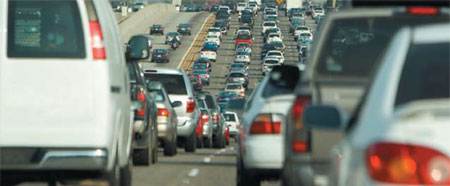
You’ll likely pay more than $3 a gallon for gas next spring.
But you’ll probably keep paying the same 18 cents per gallon federal gas tax — which has lost more than a third of its purchasing power since it was last raised in 1993.
The roads you drive on will get worse. Transit will face ongoing challenges.
That’s what appears in the fog ahead as Republicans take back the U.S. House amid the worst financial crisis since the Great Depression. Feeding voter sentiments are widespread fears about rampant spending and taxing.
Incoming Transportation Committee Chairman John Mica of Florida told reporters last week that the gas tax will go nowhere — which mirror’s President Obama’s position — and that he wants to reconsider recent high-speed rail grants.
But Mica also said he’ll grab hold of a stalled $500 billion six-year transportation reauthorization bill, now a year overdue, and work to push it through. The bill is twice as much as the 2005 law and twice as much as what the gas tax will bring in.
Even so, the massive bill still falls some $150 billion short of just being able to maintain what we have, indicates a report headed by two former U.S. transportation secretaries. And that’s just the federal gap — states and local entities have holes too.
We are facing an “elegant degradation” of our transportation system, the report warns. It will be slow, sure and very costly.
SOURCES:
- Federal gas-price predictions
- St. Augustine Record report
- Reuters report
- New York Times report
- Well Within Reach report
OTHER STUDIES:
Gas taxes Toll roads: election Governor
by Brian
Comments Off on Governors’ transpo planks
Governors’ transpo planks
Well over a month ago now, I critiqued Kay Bailey Hutchison’s transportation policy plank of her gubernatorial platform. I had intended to review the other candidate’s proposals soon thereafter, but alas, got sidetracked. With the primary elections tomorrow, I thought it might be time to finally get to it. 🙂
The candidates’ (major candidates only) policy statements are evaluated in order of their current polling numbers, Republicans first.
Construction suppliers rally for new fed transpo bill
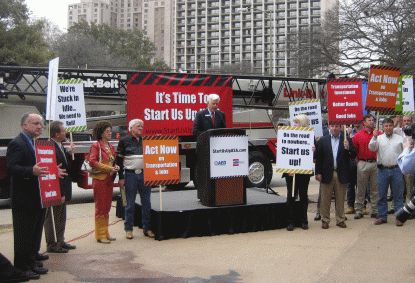
Congress has yet to approve a new, comprehensive surface transportation bill to replace the previous legislation (known as “SAFETEA-LU”) that expired last year, instead opting to keep it on life-support through a series of short-term extensions. The resulting lack of certainty over future funding– as well as limited funding in those extensions– is severely crippling the construction industry, that according to several speakers at a noontime rally outside San Antonio’s convention center yesterday that attracted about 100 people.
Kay’s transportation vision less than 20/20
 For the past week or so, I’ve been watching the drama unfold as Kay Bailey Hutchison announced the transportation plank of her platform for governor and the ensuing television ad and Rick Perry’s counter-ad. The use of the DMS signs was clever, but her message shows a both continuing lack of understanding of the core issues on her part as well as a bit of a dichotomy.
Gas taxes Laws and policies Roads Toll roads: CDAs MPO pass-through financing planning Prop 12 funds stimulus funds TURF
by Brian
5 comments
TURF: “MPO rams 37 toll projects down San Antonians’ throats”
 During my daily review of transportation news, I came across this the-sky-is-falling press release by staunch toll-opponent Terri Hall and her TURF organization. As usual, TURF shows a continued lack of insight of what’s actually happening and peppers the article with their predictable array of tried-and-true rhetoric, fallacies, and mendacities as they denounce the large number of projects that are listed as possible toll and Comprehensive Development Agreement (CDA) projects in the new 25-year regional transportation plan. Yes, there are a substantial number of toll-option projects in the plan. However, the outright panic by TURF is premature and demonstrates their failure to see and comprehend the bigger picture and actually jeopardizes badly-needed future projects.
The man who gets it
(Note: Sorry about the dearth of posts last week– I was sick most of the week.)
Late last week, state Senator John Carona (R-Dallas), who chairs the Senate’s Transportation and Homeland Security committee, proposed a 10 cent increase in the state’s gas tax to bolster dwindling funding for roads. (Express-News story)
This, my friends, shows real courage and a real understanding of the transportation funding crisis that has lead to the plethora of toll road projects around the state.