Gas taxes History Roads Toll roads: Alamo Regional Mobility Authority Loop 1604 MPO Texas Department of Transportation US 281 widening
by Brian
Comments Off on Why haven’t they widened Loop 1604?
Why haven’t they widened Loop 1604?
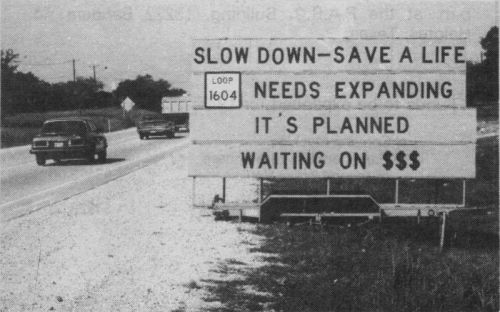
A sign on Loop 1604 in 1983 – It’s just true today as it was then!
One of the biggest gripes among San Antonio drivers is that Loop 1604 North, from roughly Bandera Rd. to I-35 on the northeast side, is still just two lanes each way and, as a result, is often congested. It may seem like TxDOT isn’t doing anything about it, but that’s not the case. An expansion of 1604 has been in the works since the last millennium, but has gotten sidetracked for several reasons over the years. Fortunately, there is light at the end of the proverbial tunnel.
The Flyover Fairy finally blesses San Antonio
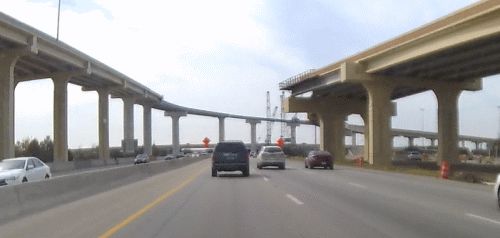
Framegrab from dashcam video of work on the SH 151/Loop 410 interchange flyovers
Ask any roadgeek (yes, it’s a thing) and they’ll tell you that nobody (perhaps with the possible exception of California, blah!) does freeway flyovers like Texas. And in Texas, Houston was once the undisputed King of the Flyover, although Dallas had had a nice collection of big– albeit cookie-cutter– interchanges since the ’70s even before the impressive “High Five” interchange came along in 2005. But while doing a drive through of the abundant road work over in the SH 151 and US 90 areas here in San Antonio earlier this week, I couldn’t help but be impressed by dizzying number of flyovers now under construction here and it got me to thinking about the number of such interchanges either already open, under construction, or coming soon here in “the 210” (or is it now “the 210/726”?)
Passenger rail Transit: commuter rail light-rail
by Brian
Comments Off on The difference between commuter rail and light rail (redux)
The difference between commuter rail and light rail (redux)
I wrote about this back in 2010, but I feel it needs a revival after seeing yet another story in the local media referring to the once-proposed rail project between San Antonio and Austin as “light rail”. This is incorrect– that project, known as Lone Star Rail or “L-Star”, was to be a commuter rail line, not light rail. It’s not just semantics– there is a big difference in the two. Unfortunately, “light rail” continues to be a buzzword that people around here use without fully understanding what it actually means.
Commuter rail typically uses large, Amtrak-style trains running at fairly high speeds on completely dedicated right-of-way with limited, widely-spaced stops and schedules more oriented to twice-a-day commuters, meaning midday and weekend service is infrequent or even non-existent. This was the type of service planned between San Antonio and Austin. The TRE train between Dallas and Ft. Worth is an example of such service here in Texas.
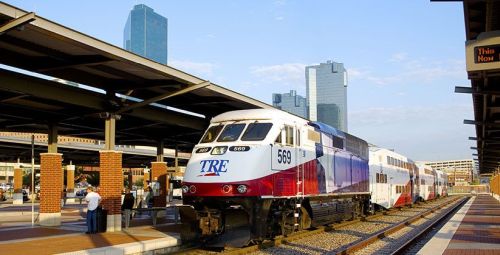
TRE commuter rail
Light rail (LRT), on the other hand, uses smaller, lighter trains (thus the term “light” rail) that more closely resemble large streetcars than they do “regular” trains, run at somewhat slower speeds, often run in dedicated rights-of-way but sometimes run on streets, have rather closely-spaced stations or stops, and have fairly frequent schedules and short headways (time between trains) all day long. This is likely the type of rail service that would be built by VIA in San Antonio if they build a rail line someday although there has been some discussion of building a commuter rail route using the rail line between downtown and the RIM. DART in Dallas and Metro in Houston are examples of LRT in Texas.
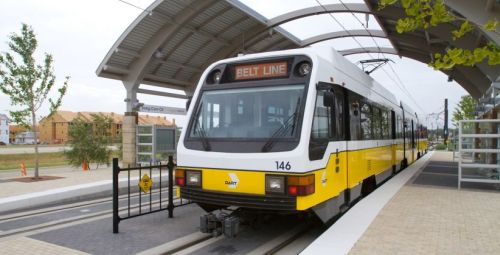
DART light rail
Some other differentiations: Commuter rail trains are much longer than LRT trains and connect the central city to the suburbs while LRT trains typically run mostly within the main urban area (in San Antonio, that would be within Loop 1604.) Also, commuter rail trains are frequently diesel-powered, while LRT trains are almost always electric-powered.
Of course, just to confuse things, there are exceptions, including one just 70 miles up the road (or track as it were): Austin’s MetroRail commuter rail service uses diesel-powered LRT-style trains for what is actually a commuter rail service.
Hopefully this will put an end to the frequent misuse of “light rail” around here to refer to the possible rail service between SA and Austin, although I doubt it.
If you want to learn about the different types of rail systems, Wikipedia has a nice overview here. Denver’s RTD also has a nice write-up. And see “How does commuter rail differ from light rail and heavy rail?”
DRIVING TIP #4: Don’t drive with your disabled placard on your mirror
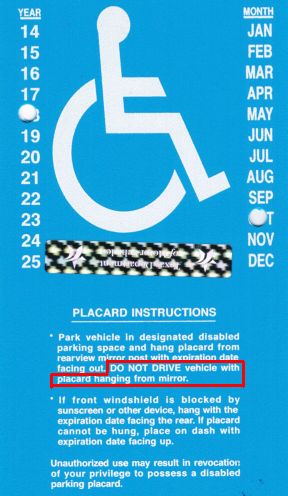 How often do you see someone driving around with the big, blue (or sometimes red) disabled parking placard hanging from their rearview mirror? If you’re like me, probably all the time.
If you’re one of those people doing that, then you’re doing it wrong.
Besides the fact that it explicitly says “DO NOT DRIVE vehicle with placard hanging from mirror” in the instructions on the back of the permit (yes, you’re supposed to take the time to read those words there), and although it’s not specifically illegal, it should be common sense that leaving something that big on your mirror while driving blocks a non-trivial portion of your field of vision, an inherently dangerous proposition. Admittedly, it’s maybe 10% or so of your view, but something could be in that area that makes all the difference, so why take that chance? It only takes a couple of seconds to take it down from your mirror before driving and put it back up there when you park in a reserved spot.
Automobiles Laws and policies Safety: Driving tips
by Brian
Comments Off on DRIVING TIP #3: Wait in the intersection to turn left
DRIVING TIP #3: Wait in the intersection to turn left
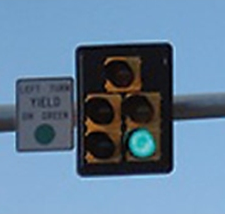 In my previous tip, I discussed not blocking intersections. Today, I’ll discuss a time when it’s okay to wait in the intersection.
Sometimes you’ll come to an intersection where you want to turn left and there’s a flashing yellow arrow or a circular green signal but no green arrow at the time you want to turn. In this situation, I usually see people dutifully wait behind the stop line. Then the light turns red and they’re still sitting there. Even worse are intersections that don’t have a protected left arrow at all– I’ve seen people wait behind the line through multiple cycles because oncoming traffic is too heavy to allow them to turn. Occasionally they’ll even give up.
Instead of waiting behind the line, the best thing to do if you need to wait to turn left is to move part of the way into the intersection and wait there. Then, if the light turns red before you’re able to turn, the oncoming traffic will stop and you can complete your turn.
Automobiles Laws and policies Safety: Driving tips
by Brian
Comments Off on DRIVING TIP #2: Don’t block the box!
DRIVING TIP #2: Don’t block the box!
 This week, San Antonio police began targeted enforcement of the state’s law against stopping in an intersection. The stepped-up enforcement is part of a pilot project called “don’t block the box”, where the “box” is the intersection and adjacent crosswalks. The program is modeled on similar programs in other cities. Ten problematic intersections all over San Antonio are part of this pilot project and have had signs like the one shown here installed. (Understand, though, that the law applies to all intersections, not just those marked with signs.) This is a statewide problem, so keep reading even if you’re not in San Antonio.
Automobiles Laws and policies Safety: Driving tips
by Brian
Comments Off on DRIVING TIP #1: Scan the road
DRIVING TIP #1: Scan the road
For this first bite-sized driving tip, I’m picking a topic that’s not even discussed on my Texas traffic laws page— scan the road.
Driving down the right lane of a major street recently, I crested the top of a hill and immediately saw a stalled truck in my lane nearly a mile down the road. Traffic in both lanes was light enough to easily change lanes, so I moved to the left lane as soon as I saw the hazard. There were two other cars traveling in the right lane ahead of me and BOTH of them continued down the lane until they were nearly on top of the broken-down truck. At that point, they had to hit their brakes and make a sudden lane change to avoid hitting it.
“WTF? Are these people blind?”
Automobiles Laws and policies Safety: Driving tips
by Brian
Comments Off on Driving tips coming soon
Driving tips coming soon
The top-viewed page on my website texashighwayman.com is consistently the page on Texas traffic laws. It’s obviously a topic lots of folks are interested in. And from what I’ve seen on the roads, lots more folks need to look at it. 🙂
While that page was initially intended to highlight common questions folks have, it’s become quite comprehensive over the years. If you take the time to read the whole thing, it’ll take you while and you’ll feel like you’ve been drinking from a fire hose. So, I’ve decided to parcel-out some of the topics from that page in smaller doses here over the next few months, along with some additional tips that aren’t covered on that other page.
If you’re interested, I’ll announce postings on my Twitter and Facebook pages or just check back here periodically.
Until then, drive safely!
more »
Data visualizations Laws and policies
by ptdriscoll
Comments Off on What drives income inequality?
What drives income inequality?
If we agree that too much wealth in the hands of too few stymies the economy, and even democracy, what do we do?
With the middle class losing ground despite healthy corporate profits, politicians and pundits gladly harp on tax rates, migrant populations and other soft targets to prescribe solutions for growing income disparities.
I decided to see what the data says.
Using World Bank datasets, I analyzed more than a dozen factors to see how they might relate to income distribution, defined here as share of income held by a country’s top 10 percent of earners.
Commuting Roads Transit: HOV lanes I-10 Texas Department of Transportation US 281 widening
by Brian
Comments Off on Not gonna use the HOV lane? It still benefits you!
Not gonna use the HOV lane? It still benefits you!
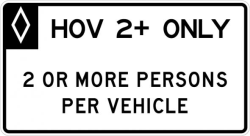
TxDOT is preparing to build San Antonio’s first two high-occupancy vehicle (HOV) lanes on I-10 West and US 281 North. Construction of both is scheduled to start this year.
One comment I frequently hear about HOV lanes is from people saying they won’t use them, so they won’t benefit from them. A corollary of that is that people who won’t use them don’t think their tax money should be spent on them. As is often the case, both of these viewpoints fail to see the bigger picture.